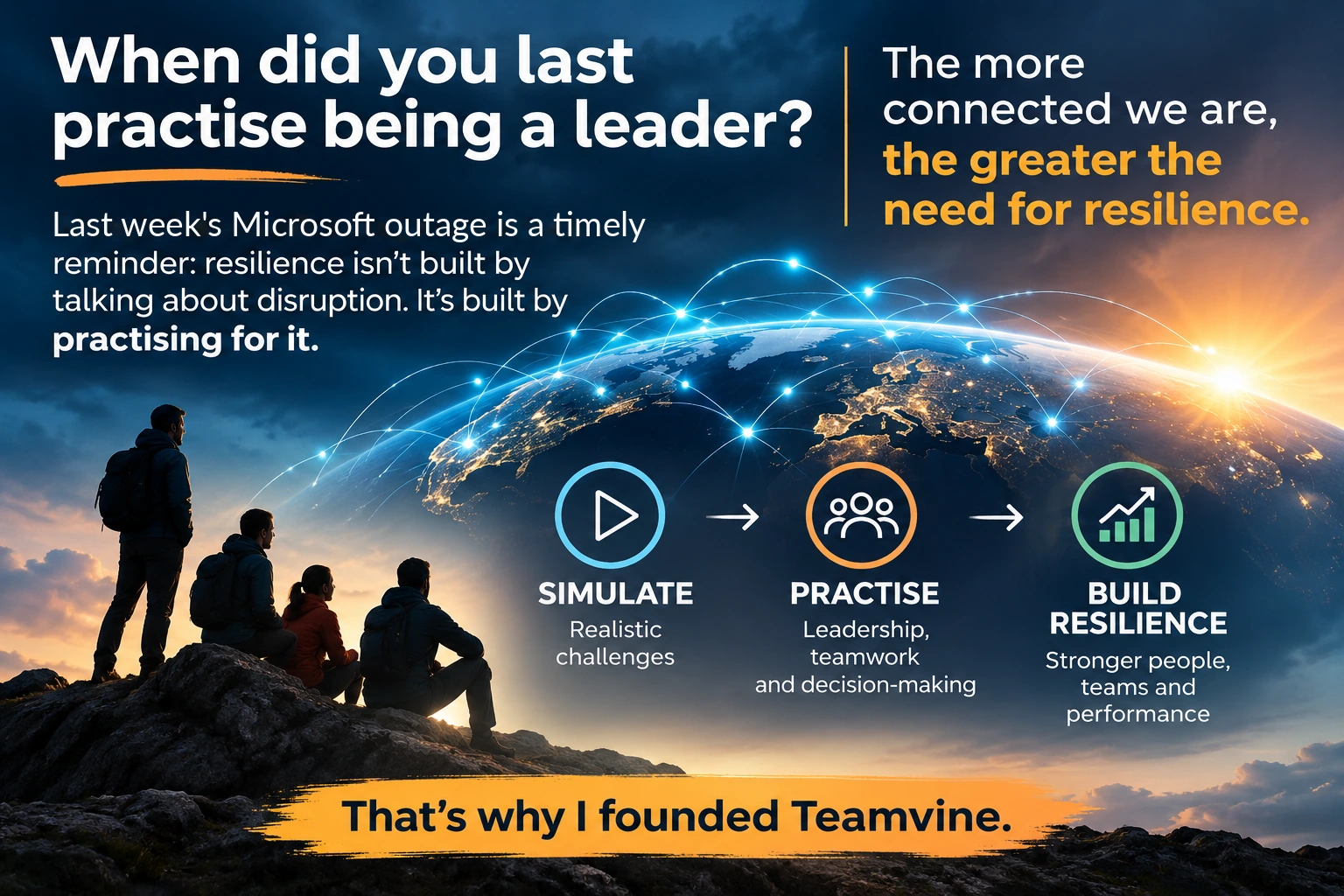
The more connected we become, the greater our need for resilience. And resilience isn’t built by talking about disruption. It’s built by practising for it.
Connectivity increases opportunity. It can also amplify disruption.
The Microsoft 365 outage of 12–13 November 2026 disrupted familiar ways of working across businesses and public services. Outlook, Teams and other services were affected. For a moment, the invisible dependencies on which our working lives rely became very visible.
Listening to a BBC World Service discussion about the outage, I kept returning to one thought: resilience is not something we acquire by writing a plan. It is something we develop through practice.
Of course we need sound systems, contingency plans and standard operating procedures. But we also need people who have experienced uncertainty, discovered how they behave under pressure and rehearsed better responses together.
When did you last practise being a leader?
I ask this in leadership workshops. The answer, almost without exception, is: “We don’t.”
An elite golfer doesn’t use the final round of a major championship to practise a difficult shot. A tennis professional doesn’t wait for a Grand Slam to discover whether their backhand holds up. They drill. They rehearse. They examine mistakes. And then they practise again.
Yet in organisations we ask leaders to navigate complex challenges, make commercial judgements, communicate under pressure and collaborate across boundaries, often without giving them a safe place to practise any of it.
The thinking is established. The practice is too often missing.
Four influences on my thinking:
- David Kolb: experience becomes learning when we reflect on it, make sense of it and experiment again.
- Peter Senge: teams need practice fields in which to explore decisions and understand the wider system.
- Edgar Schein: better learning needs genuine inquiry, candour and the confidence to surface uncomfortable truths.
- Steve Jobs: begin with the human experience you want to create, then design the technology around it.
Two moments that stay with me
Across decades of designing experiential learning, I have seen the same thing: when people are immersed in a credible challenge, the quality of their thinking changes.
2018, NHS national procurement: 150+ people exploring the unthinkable
In our 3zone Technology Event, we stress-tested future scenarios, including a global pandemic. We weren’t predicting COVID-19. We were giving people the opportunity to question assumptions, examine their response and learn together.
Oil and gas leaders: a £10m commercial tender, simulated
Twelve leaders applied leadership thinking and commercial judgement to a demanding tender simulation. The gap between their predicted performance and the simulation’s feedback created curiosity, reflection and a palpable desire to learn.
Move from a document to a practised capability
What organisations can actually do:
- Simulate: make it real. Put teams inside a credible challenge where choices have consequences.
- Reflect: make it visible. Explore what happened: behaviours, assumptions, communication and decision-making.
- Rehearse: make it stick. Practise a better response and translate learning into useful playbooks and habits.
Sometimes resilience begins with a phone call
During the outage, both my daughters-in-law phoned me. Unusual, because they would normally WhatsApp. One is a project manager; the other works as a PA to a headmaster.
Their explanation was wonderfully simple: Outlook was down, so they picked up the phone.
No playbook. Just initiative, judgement and a willingness to adapt. There is a lesson in that too.
Practice before the pressure arrives
I founded Teamvine because I wanted teams to have more opportunities to experience realistic challenges, see how they actually work together and learn from the consequences of their decisions. Not simply more leadership theory, but a practical way to turn knowing into doing.
Simulation cannot prevent the next outage. But it can help people become more adaptable, more connected to one another, and better prepared when familiar systems stop working.
When the next disruption comes, will your team have a plan, or will it have practised?
Explore Teamvine simulations 👉
Context: The Microsoft 365 service disruption occurred on 12–13 November 2026. Background reporting: BBC News, 13 November 2026 and UK Parliament, ministerial statement, 16 November 2026. Workshop and family anecdotes are first-person recollections.