Before We Break Our People
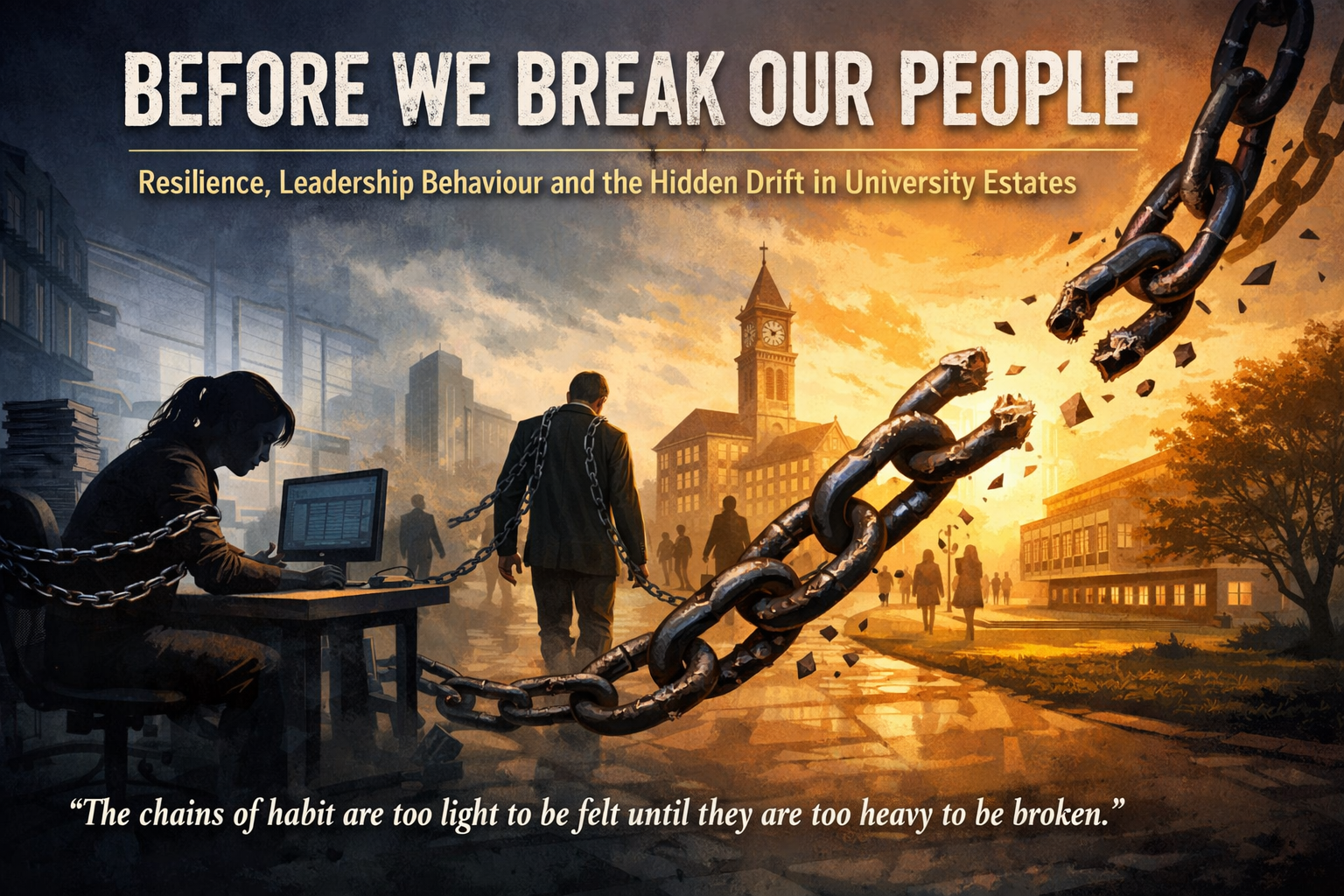
“The chains of habit are too light to be felt until they are too heavy to be broken.”
— Warren Buffett
I recently spent a day with more than 60 Estates and Facilities Directors from universities across the UK. The morning began, appropriately, with data. In an ideal world, what data would we want?
Asset registers.
Utilisation rates.
Occupancy.
Energy volatility.
Succession risk.
Dashboards that genuinely steer decisions.
Then came visualisation. APIs. Scorecards. Turning spreadsheets into strategic maps that drive prioritisation. It was impressive. And necessary.
Because Estates and FM functions sit directly behind staffing as one of the largest cost centres in most universities. When budgets tighten, estates becomes a target. When scrutiny rises, estates becomes accountable. When volatility increases, estates absorbs it.
But as the table discussions deepened, the tone shifted.
Doing more with less.
Redundancies.
Critical knowledge walking out of the door.
We’re filling “round hole gaps with square pegs.”
Escalating utility costs in under-occupied buildings.
Deferred capital.
Compliance pressure.
Hard and Soft FM under strain.
A culture of “we tried that once and it didn’t work.”
And then one delegate said it plainly:
“We’re going to break our people.”
That changed the conversation.
Pressure is structural:
Higher education is not facing a short-term squeeze.
Financial constraint.
Erosion of sector terms and conditions in roles that often already pay less than the private sector.
Attrition.
An inability to recruit.
Experience dilution.
Square pegs in round holes.
In some institutions, there is even quiet discussion about existential threat.
This is structural pressure, but here’s the nuance, pressure does not directly break people.
Leadership behaviour under pressure does.
What 40 years of research shows
Across more than four decades of longitudinal research, involving over 70,000 leaders across sectors and geographies, a consistent pattern emerges:
Leadership behaviour shapes organisational climate.
Organisational climate shapes health and performance outcomes.
Not personality.
Not intent.
Not even technical capability alone.
Behaviour.
When leaders consistently balance:
- Clear direction
- Genuine concern for people
Climate strengthens.
When pressure pushes leaders into:
- Control without concern
- Concern without clarity
- Or quiet withdrawal
Climate erodes.
And climate erosion shows up in ways we all recognise:
Reluctant compliance.
Disengagement.
Defensiveness.
Increased absence.
Reduced initiative.
Mimicry of negative behaviours.
In the research comparing outstanding and average-performing business units, the differentiator was not IQ or technical skill. It was the ability to hold clarity and humanity together under strain.
Explore the Research
For those who want to explore the original health and performance studies in more depth.
If you would like copies of the research papers please complete the short form at the end of this blog.
The research explains the behavioural patterns and the organisational climate dimensions referenced in this article.
If you would prefer a short executive summary rather than the full papers, feel free to message me directly.
The drift we notice too late
Under pressure, leaders drift. Not because they lack commitment…Because they are human. And our people do notice. They notice the shorter conversations. The sharper tone. The reduced availability. The “just get it done” energy.
Climate doesn’t fall invisibly. It falls in response.
What is harder to spot is the moment the behavioural shift begins.
The first-time direction outweighs concern.
The first-time clarity gives way to control.
The first-time protection becomes silence.
Those shifts feel small in the moment. But repeated under sustained pressure, they reshape climate. And climate, not workload alone, determines whether teams stretch or fracture.
By the time we consciously register the drop in trust or discretionary effort, the pattern has already formed.
That is the drift.
Skill erosion is real but climate multiplies its impact.
The room was clear: there is skill erosion.
Critical knowledge is leaving.
Recruitment is harder.
Experience is thinning.
Skill erosion hurts performance.
But climate erosion multiplies the damage.
A team with strong climate stretches, mentors, adapts and compensates.
A team with weak climate fragments under the same constraints.
Behaviour creates climate. Climate determines how well teams absorb structural strain.
Resilience is designed, not declared
If resilience is not endurance, what is it?
Three practical disciplines emerged from the discussion.
1️⃣ Build clarity under constraint
External pressure increases ambiguity.
Ambiguity increases stress.
Resilient estates functions reduce noise.
That looks like:
- Three to five non-negotiable operational priorities per quarter
- Explicit trade-offs (“We are pausing X to protect Y.”)
- Visible alignment between strategy and daily activity
- Clear service thresholds when capacity is stretched
Clarity reduces rumination.
Reduced rumination lowers stress.
Lower stress increases performance capacity.
2️⃣ Protect climate, not just capability
Most estates teams are technically competent.
Resilience is rarely lost through skill failure alone.
It is lost through climate erosion.
Under pressure, teams look for:
Clarity.
Fairness.
Predictability.
Recognition.
Involvement.
Appropriate autonomy.
These generate something vital in constrained systems…Discretionary effort.
The margin between:
“Doing the job”
and
“Caring about the job.”
3️⃣ Design recovery, not heroics
University estates functions are prone to reactive loops.
Crisis to crisis.
Project to project.
Inspection to inspection.
Resilience requires rhythm.
That might mean:
- Recovery windows after peak periods
- Post-pressure debriefs (“What drifted? What worked?”)
- Visible acknowledgement of sustained effort
- Rotational load-sharing in high-intensity roles
Without recovery cycles, even strong teams fracture.
From insight to practice
The Blue4 research explains why behavioural balance matters under pressure.
It links to a short piece on how digital experiential rehearsal environments allow teams to strengthen behaviour under pressure in focused, time-efficient sessions designed specifically for operational leaders where time is scarce.
The research explains the patterns.
The digital tools allow teams to experience and strengthen them without stepping away from operations for extended periods.
Closing invitation
If any of this resonates, I would genuinely welcome a follow-up conversation. Not a presentation and not a pitch simply a short, structured discussion to understand the specific pressures in your institution and where resilience is being stretched.
Every university is different. The patterns are shared. The constraints are not.
If helpful, I can offer a brief “Resilience Under Pressure” diagnostic conversation to explore:
- Where skill erosion is creating operational risk
- Where leadership drift may be showing up most
- Which climate dimensions feel strongest or most fragile
- One or two practical behaviour shifts that would reduce pressure fastest
If you’d like to continue the conversation, message me directly and we’ll set up 30 minutes.
Sometimes the most valuable next step is simply a clearer diagnosis.
Derek Peacock
CEO, Teamvine
📞 +44 (0) 7860 714688
🔗 Derek Peacock | LinkedIn